
Before we begin, don't forget to subscribe to my YouTube channel HERE . It will be a great motivation for me to continue creating more engaging content. Thank you for your support.
Kyoto is known as a city with an extremely mild, pleasant climate, with summers that are not too hot, and winters that are not too cold. That is why we rarely see snowfall here, except for some places located on high mountains such as the ancient village of Kayabuki no sato , or Kifune Shrine - the place I will introduce to you today.
Most tourists hop on a bus straight to Kifune, unaware that they’re missing out on countless hidden gems along the way. Today, let’s take the scenic route and discover this enchanting destination the way the locals do!
- First location: Kurama Dera Temple.
Address: https://maps.app.goo.gl/viwgVJyHzW8sHKSe7
How to get there: First, take the Keihan line to Demachiyanagi station, then transfer to the Eizan line, get on the train and go to Kurama station (right after Kibune guchi station - the station where people often get off to take the bus to Kifune shrine).

The train to Kifune doubles as a scenic sightseeing ride, featuring seats arranged horizontally to face the windows, allowing passengers to fully take in the breathtaking views. This journey becomes especially mesmerizing in autumn, when the landscape is painted in vibrant red hues, and in winter, when snow blankets the rooftops, creating a picturesque wonderland.


After approximately 25 minutes on the train from Demachiyanagi Station, we arrive at Kurama Station—a charming stop with an ancient ambiance. The station is adorned with numerous Tengu masks, mythical creatures deeply rooted in Japanese folklore and revered as divine beings in Shinto beliefs.

Tengu (天狗) is easily recognized by its striking red face, furrowed brows, and an exceptionally long nose, giving it a fierce and mystical appearance.

Around Kurama Station, you'll find many shops selling souvenirs, especially figurines and items inspired by Tengu, making it a great place to pick up a unique keepsake.


After strolling for about 3–5 minutes past the souvenir shops, we arrive at the entrance gate of Kurama-dera Temple, marking the beginning of our journey into this historic and spiritual site.

The map also numbers and annotates the locations we will pass through, starting at Nio-mon (entrance gate) and ending at Kifune Shrine – the main location of today.
Right in front of the entrance gate, there’s a restaurant serving specialties of Mount Kurama. Be sure to try a few dumplings before stepping inside—you won’t regret it!


Admission is 500 JPY for adults and 250 JPY for children.


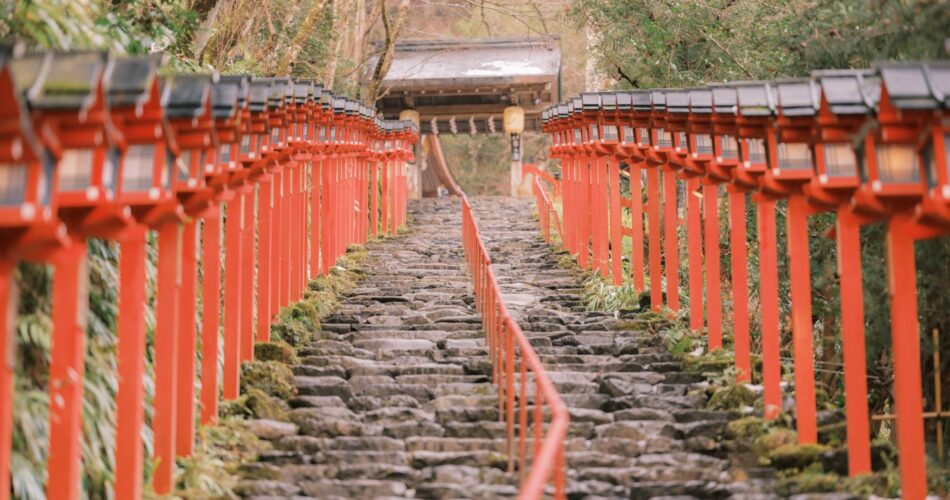
The entrance is beautifully lined with red lanterns, creating a striking and iconic scene that embodies the charm of Kifune.
Right at the entrance, there will be a cable car that goes straight to the main temple of Kurama Dera, because the climbing distance is quite long, suitable for families with small children, or those who are not used to climbing mountains regularly. The cable car will go from point 6 to point 9 (on the map). You can download the map directly for easy tracking HERE .

Let's see what's on the walking trail.


The trail is quite steep and long, even for someone used to mountain climbing like me, it was quite tiring. So I recommend everyone take the cable car to save energy for the hike to Kifune.


Ngôi đền này thờ Sonten, ba vị thần được cho là đã tạo ra vũ trụ ( Maōson, Bishamonten và Senjū Kannon). (Nguồn: Kurama-dera | Discover Kyoto)


In front of the main hall, you'll find two majestic tiger statues standing as guardians, symbolizing protection and strength.


Some pictures around Kurama Dera temple:


After exploring the temple, visitors can follow the signs to walk straight to Kifune, following the route from point 29 to point 41 on the map. The distance is about the same as the climb up, making for a balanced and scenic descent.

The mountain climbing path from Kurama to Kifune is called the sandō (sacred path) with many large and small shrines along our way.


The scenery along the way is truly majestic, with hundreds of towering Japanese cedar trees creating a serene and mystical atmosphere. Their massive trunks and intertwining roots add to the ancient charm of the trail, making the journey feel like a step back in time.
After about 30 minutes of hiking, mostly downhill, we arrive at the entrance gate of Kifune, marking the beginning of our exploration of this charming and sacred village.
Address: https://maps.app.goo.gl/UMs3QfsnYwVreXYQA

And here it is—the iconic and breathtaking sight of Kifune. Stone steps lined with dozens of vibrant red lanterns stretch all the way to the entrance gate, creating a picture-perfect scene that feels straight out of a postcard.


Kifune is revered as the dwelling place of the Water God, attracting visitors who come to pray for good health, bountiful harvests, and blessings related to water and life.

This place is also famous for its unique Omikuji fortune-telling. Unlike traditional paper fortunes, here you can only reveal your fortune by placing the card in the sacred water next to the temple, where the hidden message slowly appears.

The fee for omikuji here is 200 JPY. Simply place the exact amount in the box on the left, pick any card you like, then bring it to the water and gently place it in to reveal your fortune.

Let's see how the words on the hexagram appear:


… will slowly display the entire content.
Don't worry if you don't understand Japanese! You can simply scan the QR code on your omikuji to instantly translate the meaning into your language, making it easy to understand your fortune.
My fortune today is "minor good fortune," so I'll keep it. If your omikuji predicts bad luck, you can tie it up in the designated area where others have left their unfavorable fortunes, following the tradition of leaving bad luck behind.

In addition to its enchanting winter scenery, Kifune is also a popular summer destination, known for its unique dining experience. Dozens of restaurants line the picturesque waterfalls, offering visitors the chance to enjoy delicious meals while listening to the soothing sound of flowing water.

This place is also renowned for its bamboo noodle soup, a specialty of Kifune. Let’s visit Hirobun (ひろ文), a famous restaurant where you can experience this unique dish in an unforgettable setting.
Address: https://maps.app.goo.gl/WwXo6uyQinMQ9gdx5

The noodles flow down through bamboo tubes, with each person having their own section. The challenge is to catch the noodles as they pass by and enjoy them with the flavorful broth provided. It’s a fun and unique experience, making it a must-try when visiting Kifune in the summer.

After exploring and capturing the beauty of Kifune, you can head back by train from Kibuneguchi Station, which will take you directly to the final stop at Demachiyanagi Station.
Kibuneguchi Station Address: https://maps.app.goo.gl/UQeYnSwYCm3UaxRW7
From Kifune Shrine to Kibuneguchi Station is about 2 km. You can take a leisurely walk to enjoy the scenic surroundings or hop on a bus for a quicker and more comfortable ride to the station.

This wraps up a full day of exploring Kifune, a breathtaking destination that shines in all four seasons—especially in winter, when the snow-covered steps create a truly magical scene. How do you feel about Kifune? Share your thoughts in the comments below!
***************************************************************************************************************
Explore our useful services in Japan:
- Taking photos of individuals, couples, and families in Osaka, Kyoto, Nara: See more HERE
- Plan and schedule your trip to Japan: See more HERE
- eSim data, pocket wifi travel in Japan: See more HERE
***************************************************************************************************************
*** Please read the Copyright & Collaboration requirements carefully before copying or quoting the blog's content and images. Thank you.

Does this journey excite you?
If you found this blog article helpful, a cup of coffee from you would be a great boost for my next adventures.
Buy me a coffee
Claw! There's always snow. It looks like salt