
Before we begin, don't forget to subscribe to my YouTube channel HERE . It will be a great motivation for me to continue creating more engaging content. Thank you for your support.
Tsubosaka-dera is a historic Buddhist temple situated in Nara, Japan. Perched atop Mount Tsubosaka, this ancient temple dates back to the 8th century and is renowned for its breathtaking panoramic views and impressive giant Buddha statues. The best time to visit is from late March to mid-April, when the temple is beautifully enveloped in cherry blossoms, creating a truly mesmerizing sight.

You can get here by car, train, or bus. However, during cherry blossom season, I recommend taking the train or bus, as there are too many cars, causing long traffic jams, and the average travel time by car from the foot of the mountain to the temple is about 2 hours, while it only takes 30 minutes if you walk.

The closest bus stop to the temple is Tsubosakaderakuchi Bus Stop , I will leave the Google map link here: Google Map.
The closest train station to the temple is Tsubosakayama Station , address: Google Map.
After arriving at the bus station, we walk about 30 minutes to the temple. The temple address is here: Google Map.
After about 30 minutes of walking, this was the first sight that greeted me—a magnificent giant pink magnolia (Mokuren) tree standing right in front of the entrance.


Admission is 800 JPY for adults and 200 JPY for children. The temple is open from 8:00 AM to 5:00 PM, but during cherry blossom season, special lighting events extend the hours from 7:30 AM to 8:00 PM.


Right from the entrance of the temple, numerous Buddha statues of various sizes are placed throughout the area.


Right from the first steps, I was greeted by a long row of pink cherry trees stretching all the way down the path. At the end of the road stood a temple with a small Torii gate.

I like these light pink cherry blossoms more than the traditional white ones.


Entrance gate viewed from two sides. Look in and look out.
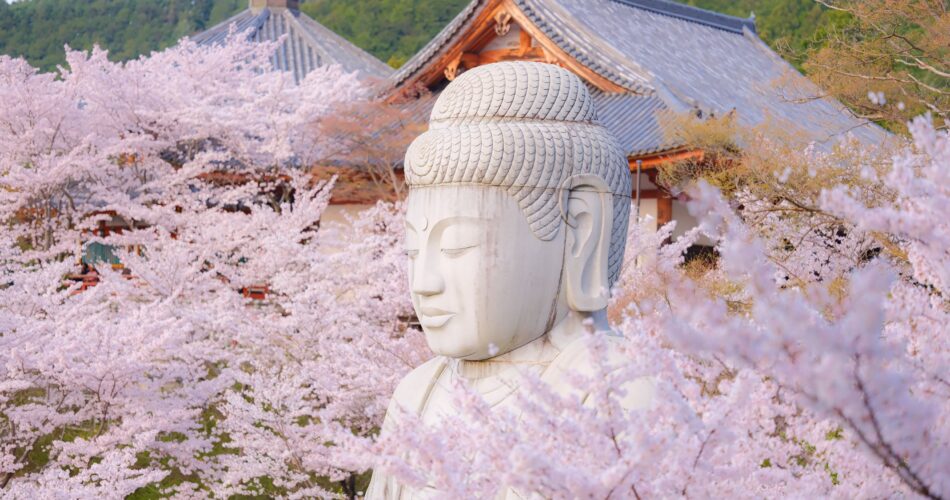
As soon as we climbed the stairs, we were greeted by a giant Buddha statue standing majestically in the midst of a cherry blossom forest. This is also one of the iconic symbols of the temple.


Surrounding the statue are pink peach blossoms.
And here's a rather special photo I managed to take. A cluster of cherry blossoms looks like they're falling, but that's actually due to a bokeh effect; you have to look quite closely to see it.

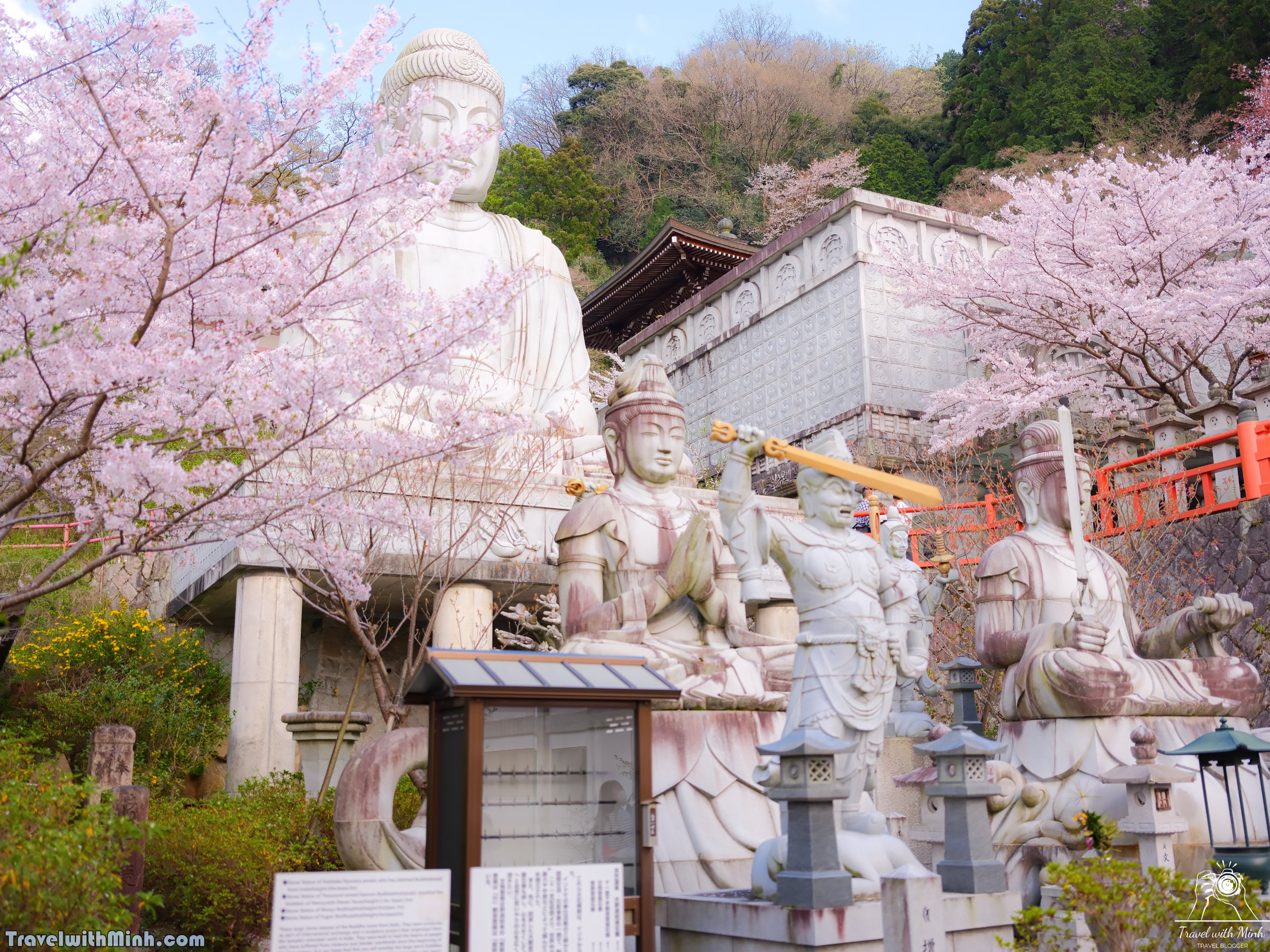
And here is a panoramic view of the large Buddha statues at the temple.

On the opposite side, there is a thousand-armed Buddha statue placed separately beneath a cherry blossom garden.

After visiting this area, we walk up the front stairs to the next areas.


On the second floor of the temple, I headed to the area specifically designated for those who want to photograph the Great Buddha from above. Since this shooting angle is quite popular, many visitors lined up at the checkpoint, waiting for their turn to take photos.

The waiting time in line was about 30 minutes, which was quite long, so I took the opportunity to capture some photos of the surrounding scenery while waiting. And here is the result:


The photo spot for the Big Buddha only allows about 4-5 people in at a time, resulting in a rather long wait. But trust me, it's worth every minute of waiting. Check out my results after 30 minutes in line:


Since I had very little time to take photos (as there were still people waiting in line behind me), I tried to capture as many angles of the statue as quickly as possible.

After taking photos at this checkpoint, you can also head down the stairs to capture the statue from a lower angle and get a closer view.

The photos were taken during the golden hour, so the lighting was beautifully soft and perfectly balanced.

There are so many different angles, and I don't want to leave any of the photos out, so I'll upload them all here.


On this lower floor, there is also a massive bell tower, which houses hundreds of small Buddha statues along with a large thousand-armed Buddha statue on the left side.


After exploring the second floor, I climbed the temple steps to the third floor, the highest level, to capture more photos of the Great Buddha statue from a different perspective.

And this is what I captured from the third floor—the entire statue, along with the surrounding temples, beautifully enveloped in cherry blossoms.

And the last place I visited was the main hall of the temple.

The Buddha statues here are a combination of Indian Buddhism and Japanese Buddhism.

Inside the main hall, hundreds of Hina dolls (traditional Japanese dolls) appear.


And at the center of the main hall sits a majestic thousand-armed Buddha statue within an octagonal structure. This temple is also well-known for prayers for good health, so be sure not to miss this sacred spot when visiting.


At the exit of the main hall, there is a large mirror placed in front of the door, so people can capture the reflection of the cherry blossoms.


A monk is performing a vow in the main hall.

When I stepped out of the main hall, the sky was beginning to darken, marking the perfect moment for the start of the lighting event.

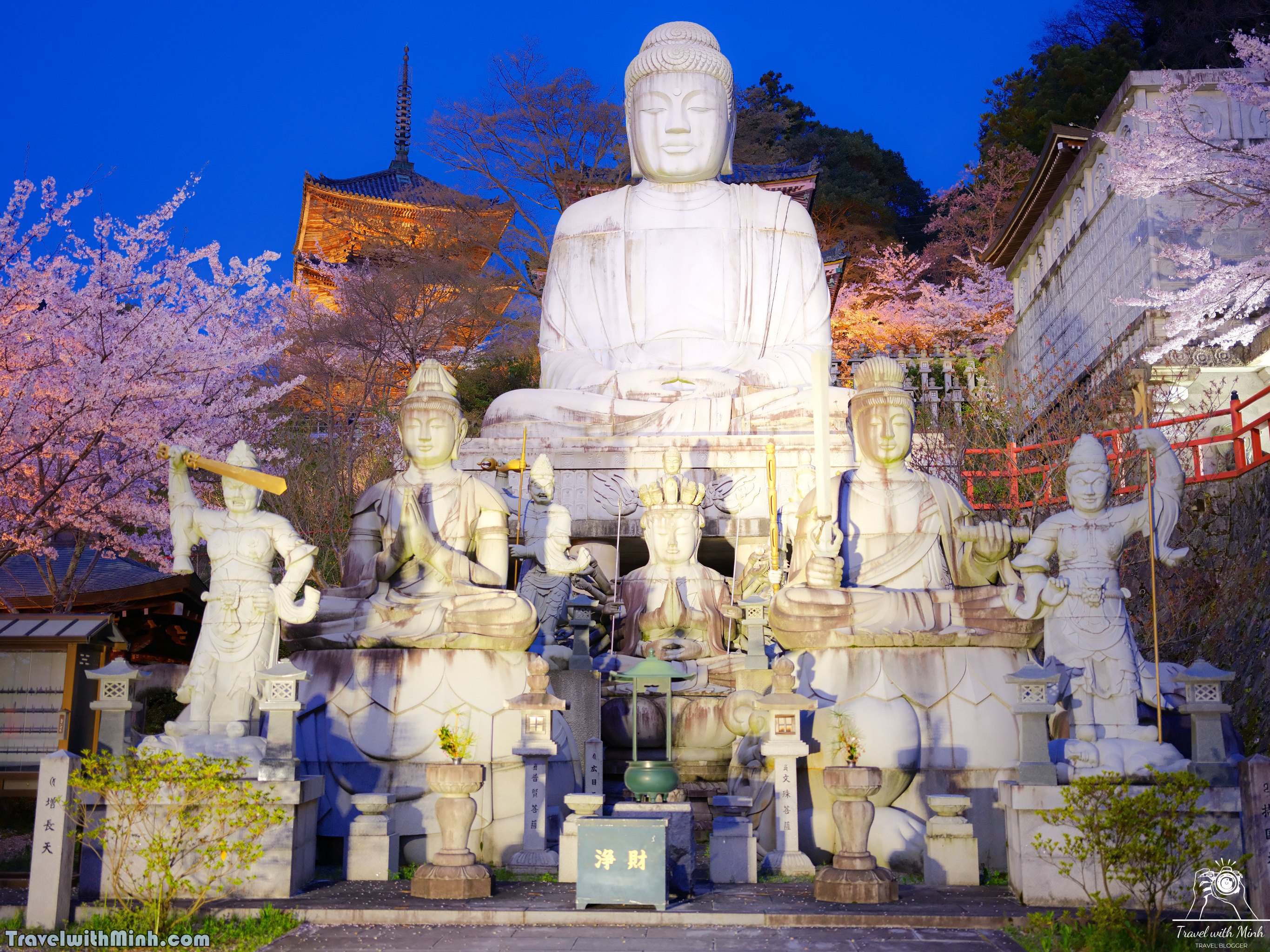
LED lights are placed around the temple, to illuminate the Buddha statues and cherry blossom trees.

And I also returned to the Buddha statues area to take photos at lighting time.
At this point, I had completed my tour around the temple, capturing its beauty from various angles. I hope this article helps you explore the temple and discover an incredibly stunning cherry blossom viewing spot in the Kansai region.

The last bus from here departs at around 7:00 PM, and the walk from the temple to the bus station takes about 30 minutes, so be sure to keep track of time when heading back. If you happen to miss the last bus, don’t worry too much—you can still walk a bit further to the train station. However, the walk is quite long (about 50 minutes), so taking the bus remains the most convenient option.
And finally, today's author photo. Thank you for reading to the end of the article.

Don't forget to follow me on Instagram ( minhh.adventure ) or subscribe to receive notifications whenever I post something new!
***************************************************************************************************************
Explore our useful services in Japan:
- Taking photos of individuals, couples, and families in Osaka, Kyoto, Nara: See more HERE
- Plan and schedule your trip to Japan: See more HERE
- eSim data, pocket wifi travel in Japan: See more HERE
***************************************************************************************************************
*** Please read the Copyright & Collaboration requirements carefully before copying or quoting the blog's content and images. Thank you.

Does this journey excite you?
If you found this blog article helpful, a cup of coffee from you would be a great boost for my next adventures.
Buy me a coffee
Beautiful photos! Thanks for sharing your experience! Do you remember what day exactly you visited? Does this temple bloom around the same time as Nara & Kyoto? Planning my Japan cherry blossoms trip and I'm not sure whether to add a visit to this temple on the same day I go to Nara (so early April) or when I go to Yoshino (so mid-April). I'm trying to figure out when exactly the trees are in bloom here relative to other spots in the area. Thank you!
Thanks so much! I visited on 7th April, on the same day I went to Yoshino Yama and Fujiwara Castle—you can also check those articles at the top of my blog.
Bloom timing in Nara is quite close to Kyoto. The main difference is elevation—places like Yoshino are higher up, so they usually bloom about 5–7 days later.
That said, timing changes every year. But generally, if cherry blossoms are already blooming in Osaka or Kyoto, it's a good sign that you can visit Tsubosaka and Yoshino around the same time.
Hope this helps with your planning—have an amazing trip and enjoy Japan 🌸