
Before we begin, don't forget to subscribe to my YouTube channel HERE . It will be a great motivation for me to continue creating more engaging content. Thank you for your support.
Koyasan (also known as Mount Koya) is a sacred mountain located in Wakayama Prefecture, about 90 km south of Osaka. It serves as the headquarters of the Shingon sect of Japanese Buddhism. Koyasan was founded in the early 9th century by the Zen master Kukai, also known as Kobo Daishi.

From a young age, Kukai demonstrated exceptional talent in studying and acquiring knowledge. In 804, after receiving a scholarship from the Emperor of Japan, he traveled to China to study Shingon Buddhism (mikkyo) and philosophy. Kukai studied at the Xuanguang Zen school, one of China’s leading intellectual and spiritual centers during that time.

During this period, Kukai gained extensive knowledge of Esoteric Buddhism and its complex spiritual practices. After returning to Japan, he founded the Shingon sect, which would become one of the largest and most influential sects in Japanese Buddhism. In 816, Kukai chose the wild and tranquil Koya Mountain to build temples, establishing it as a sacred and serene place for the practice and study of Buddhism.

And today, let’s explore Koyasan, a sacred, peaceful, and incredibly mysterious land of Japan!
Since Koyasan is located at the top of the mountain, getting there can be a bit challenging. I started from Osaka Namba Station, took the Nankai Koya Line, and reached my final destination at Gokurakubashi Station.
Gokurakubashi Station Address: https://maps.app.goo.gl/eEyJVx36mds1GutJ9
Next, move to the cable car area from Gokurakubashi Station to Koyasan Station. This was quite an interesting experience for me, very similar to the way to go to Hozan-ji Temple that I wrote about in previous posts (you can review it HERE ).

Furthermore, after arriving at Koyasan Station, I had to take a bus from the station to continue the journey up to the top of the mountain. There are two buses that go in different directions, but don’t worry—you can take either one, as both routes will eventually bring you back to visit other places in the area.
The first place I visited after reaching the top of the mountain was Kongobuji Temple.
Address: https://maps.app.goo.gl/7zHcj1kdCdPi4cTH7

Kongobuji is the head temple of the mystical Shingon sect in Koyasan, where the sect's annual prayers and rituals are held. It is an important spiritual center and a must-visit destination for anyone exploring the area.

Kongobuji Temple has undergone many repairs and expansions over the centuries, yet it still retains its classic and sophisticated architecture, preserving the timeless beauty of its design.

The next place I visited, located right opposite Kongobuji, was Benzaiten Shrine.
Address: https://maps.app.goo.gl/QF4yX14MmQ7U9qo7A

As the name suggests, Benzaiten Shrine is dedicated to Benzaiten, a deity in the Shinto religion who is considered the goddess of water, art, knowledge, and luck. I really enjoyed visiting this shrine, as the campus is quite large, and the space is calm, serene, and peaceful, offering a perfect place for reflection.

The next location, about 500 meters from Kongobuji, is Danjo Garan, the first temple complex established by Monk Kukai in Koyasan. This sacred site includes several important and revered buildings, each with its own spiritual significance.
Address: https://maps.app.goo.gl/hU3KozdRyGCg1U7b9
Since there are many temples and pagodas in this area, I will introduce a tour of each temple as we move from Kongobuji to Danjo Garan, highlighting the key landmarks along the way.
- Konpon Daito.
Master Kukai began construction of Kopon Daito shortly after 816, but did not complete it before he entered eternal meditation. Construction work was undertaken by Shinzen, his disciple and successor in Koyasan, and completed around 887.

This tower has been largely destroyed by fire due to lightning strikes five times throughout its history, and each time it was rebuilt. The most recent renovation occurred in 1996, and the tower stands about 50 meters high, maintaining the original size from the 9th century. Visitors can enter the tower, with an entrance fee of 500 JPY. Since filming and photography are not allowed inside, I will describe in detail the significance of the tower's interior below.

There are two important scriptures in Shingon: Dainichikyo and Kongochyo. Based on these two scriptures, Master Kukai visualized the truth of the universe in Kongokai-mandara (Diamond Realm) and Taizokai-mandara (Matrix Realm). He then transformed his vision into three-dimensional Buddha statues, bringing the sacred teachings into tangible form for followers to meditate upon.

Inside Konpon Daito, there is a three-dimensional Mandala statue, with the central figure being Dainichi Nyorai (the Vairocana Buddha, the main deity worshipped in Shingon Buddhism). This statue is surrounded by the four Buddha figures of the Diamond Realm (Kongokai), and sixteen great Bodhisattvas, each depicted on the sixteen pillars surrounding the space.


Konpon Daito is large and majestic, located at the heart of Danjo Garan, standing as a central and significant structure within the sacred temple complex.
- Kondo.
The Kondo serves as the main hall of Koyasan and is the site of many important ceremonies. Inside the Kondo, there is a statue of the Medicine Buddha (not on display), flanked by two mandalas with separate altars. Surrounding the hall are large paintings depicting eight Bodhisattvas. Photography and filming are also prohibited inside the Kondo, and the entrance fee is 500 JPY.


- Rokkaku Kyozo.
This is a hexagonal Buddhist scripture repository, built in 1159 to house a complete copy of the Buddhist scriptures, written in golden ink. The original 1884 version of the building could rotate on its own, but after several fires, it was rebuilt in 1934. Now, only the outer rim of the tower is able to rotate.

People often come here and use their strength to push the outer rim of the tower in a circle. This act holds spiritual significance, symbolizing respect and gratitude for knowledge and education. In Buddhism, spinning is seen as a representation of tireless wisdom and dedication to learning and spiritual development.

Additionally, spinning can also be viewed as an act of reverence and remembrance towards predecessors and saints in the Buddhist tradition. Rotating the tower is a way to honor and commemorate the merits of those who spread Buddhism and contributed to the development of the religion. It serves as a tribute to their wisdom and the lasting impact of their teachings.
- Miyashiro.
This is a complex of shrines dedicated to the Shinto gods who oversee Koyasan. When the great master Kukai consecrated Koyasan in 819, he invited two Shinto gods to stay here and protect the area, blending Shingon Buddhism with Shinto beliefs to create a harmonious spiritual environment.


Another Torii gate in the background.


Complex of temples.


- Sanko no Matsu
According to legend, when Master Kukai was preparing to return to Japan from China in 806, he threw a three-pointed vajra to the East, praying that it would guide him to the ideal location to build his monastery. It is said that in 816, he discovered the vajra pestle lodged in a pine tree at Koyasan. Interestingly, the pine tree here has leaves with three needles, unlike the usual two needles, which is reminiscent of a three-pointed vajra.

The picture above depicts several people trying to throw pine needles into the red circle, mimicking the legendary act of Master Kukai. If they succeed, they begin to pray. I tried it myself and was lucky enough to succeed on my first attempt.

- Miedo.
This place was originally used by Master Kukai for meditation. Inside, there is a portrait of Kukai himself, painted while he was still alive by his disciple, the monk Shinnyo, a former prince. This portrait is considered one of the greatest treasures of Koyasan and is not displayed to the public.

This building has been destroyed by fire three times and was rebuilt in 1848, surviving the Kondo fire in 1926. The portrait has been saved from each of these fires, and Miedo is considered one of the most important religious buildings in Koyasan (along with Okunoin – the place I am about to introduce) because of this.


- Chumon.
Chumon, also known as the middle gate, began construction in 819 and has been destroyed several times by fire, the last being in the great fire of 1843. After more than 170 years, only the original foundation stone remained. However, in 2015, the gate was rebuilt to commemorate the 1200th anniversary of the founding of Koyasan.

In addition to the two original statues, which were saved from the 1843 fire, two new statues were carved to complete the set of the four Guardian Kings. These statues are now housed within the gate, offering both spiritual protection and a symbolic presence.

So ends the journey to explore all the locations in the Danjo Garan complex. However, we’ve only completed half of the journey. Let’s continue to uncover the mysteries hidden deep within Koyasan mountain.

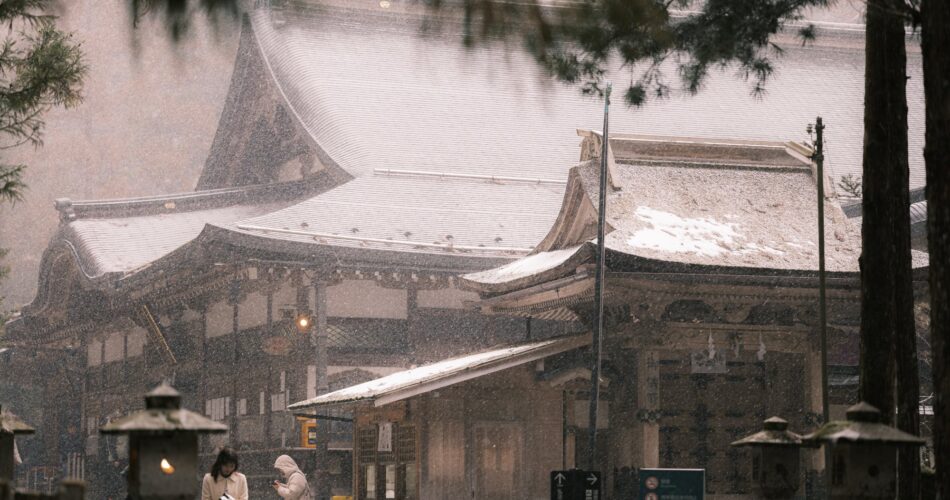
Then, I moved to the next location, about 1 km from Danjo Garan, located in the other branch of Koyasan (Kongobuji and Danjo Garan are in one branch, to the right when heading by bus), which is the Jofuku-in Temple. When I arrived at this site, the snow began to fall heavily, making the photos even more mystical.
Address: https://maps.app.goo.gl/28dyBZRW1pQAfmsH9

Jofuku-in is located in the central area of Koyasan. Although not a large temple, it attracts many visitors due to its peaceful beauty, quiet atmosphere, and striking architecture, which stands out as one of the most prominent features on the road I took from Kongobuji to here.

One of the highlights of Jofuku-in is its offering of cultural and spiritual experiences, including Buddhist teachings, prayers, and practice activities. Visitors can also participate in classes on traditional arts such as calligraphy and the Japanese lantern festival, providing a deeper connection to the temple's heritage.

In addition, Jofuku-in also offers accommodation services for tourists who wish to experience monk life for a short time. The rooms are simply designed yet comfortable, providing a peaceful atmosphere and necessary amenities for visitors to enjoy a quiet retreat on Koyasan Mountain.

Pilgrims and tourists alike can stay at shukubo (temple inns), some of which even offer luxury rooms. Visitors to Koyasan have the opportunity to enjoy shojin vegetarian cuisine, participate in meditation sessions, walk through the forest, and explore the famous cemetery, all while experiencing the serene spiritual atmosphere of the area.


I also walked the entire journey (instead of taking the bus) to fully immerse myself in the peaceful atmosphere here, while capturing the beauty of Koyasan covered in falling snow.

The next location, and also the final stop in my journey to explore Koyasan today, is the Okunoin Cemetery.
Address: https://maps.app.goo.gl/HXRUPFY1A3Ezp3sv6

This cemetery is about 2 km long, passing through tombs and memorial towers built to honor and comfort the souls of those who have passed away.

Okunoin is known as Japan's largest cemetery, serving as the burial place for many famous Buddhist monks and followers.

If you count the visible graves, there are more than 200,000 in Okunoin, with many more lying underground, making it one of the most sacred and vast cemeteries in Japan.

These memorials were placed more than 1,200 years ago and are dedicated to warlords and historical figures who left a lasting impact on Japanese history.

In particular, this place also houses the tomb of General Akechi Mitsuhide, who famously betrayed his lord, the legendary Oda Nobunaga, in Kyoto in 1582.


After his death, Akechi Mitsuhide became a sworn enemy of Oda Nobunaga. What’s particularly remarkable is that Oda Nobunaga is also commemorated at Koyasan. The two former enemies now rest side by side in the same place—Okunoin.


Let's see some extremely mysterious images inside this road:


The rows of trees are so massive that, even though heavy snow is falling outside, it’s completely shielded by the branches, like a giant umbrella covering everything beneath it.

At the end of this road lies the Gobyo mausoleum, where Kukai has meditated eternally since 835, praying for the happiness of humanity.

People continue to believe that Master Kukai is still present here, a deep conviction that has remained unchanged. The monks still bring Kukai meals twice a day as part of their ongoing rituals.

Outside are also some temples and spiritual areas.


The snow is falling thicker and thicker, creating a beautiful, serene atmosphere as everything around becomes covered in a soft white blanket.


At this point, I have completed my journey to explore the spiritual land of Koyasan, which was added to the UNESCO World Heritage List in 2004. This recognition highlights its historical, cultural, and spiritual significance, as well as the special spirit of Mount Koyasan and its crucial role in preserving and maintaining Japan's cultural heritage.

This is also an incredibly passionate article of mine, where I invested a great deal of time in experiencing, taking photos, and researching information sources in both English and Japanese, then translating them into Vietnamese. I’ve compiled everything and shared it with my real-life discovery experience. I hope this article helps everyone learn more about the culture and history of Koyasan in particular, and Japan in general.

In addition, I would also like to express my gratitude to NHK WORLD JAPAN and Monk Inaba Jijyun for providing some incredibly valuable images and information that I have cited in this article.
Thank you for reading to the end of the article!
Follow my Instagram to see photos and get the latest blog updates: minhh.adventure
***************************************************************************************************************
Explore our useful services in Japan:
- Taking photos of individuals, couples, and families in Osaka, Kyoto, Nara: See more HERE
- Plan and schedule your trip to Japan: See more HERE
- eSim data, pocket wifi travel in Japan: See more HERE
***************************************************************************************************************
*** Please read the Copyright & Collaboration requirements carefully before copying or quoting the blog's content and images. Thank you.

Does this journey excite you?
If you found this blog article helpful, a cup of coffee from you would be a great boost for my next adventures.
Buy me a coffee
This set is excellent.
I scrolled through the last few pictures and saw the snow falling and I got goosebumps
Choosing the right photo color for the scene will make you happy for days :)))